
Set Pieces in Soccer and What the Numbers Mean
See which corners, free kicks, penalties and throw-ins count as soccer set pieces, plus how providers define phases and calculate conversion rates.
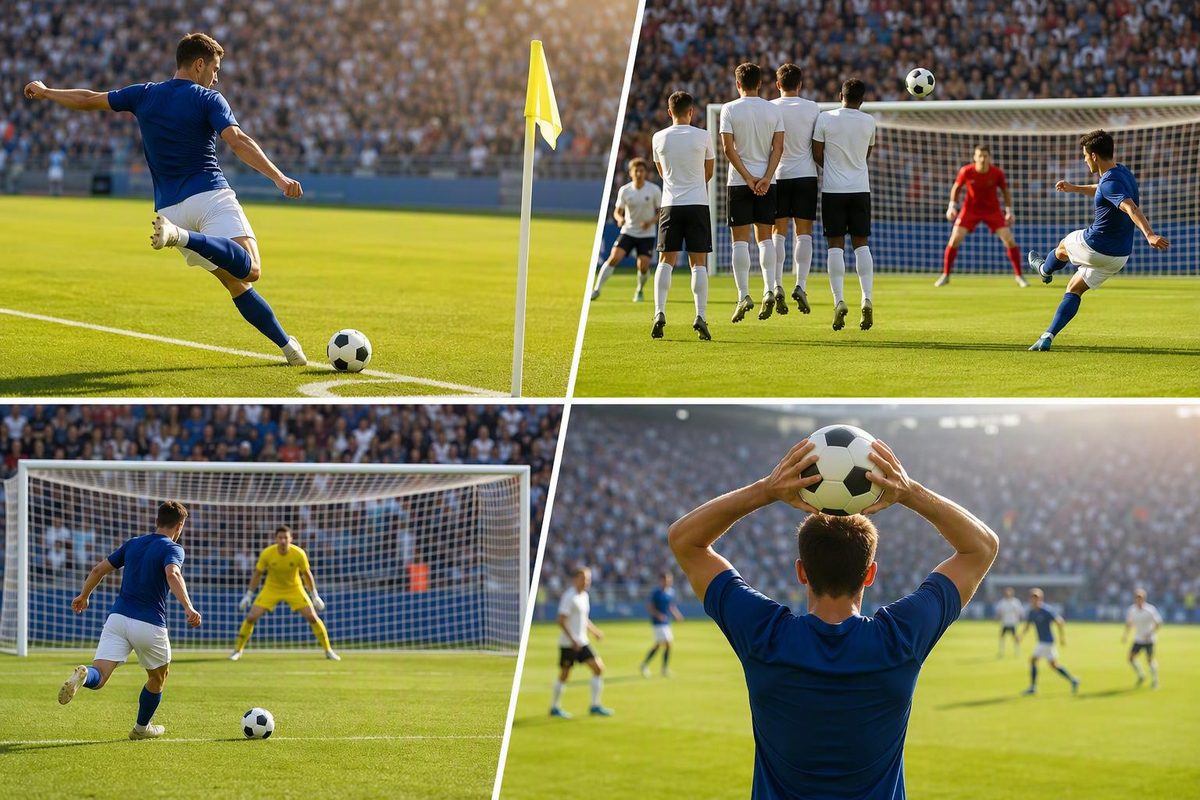
A set piece in soccer is a restart from which a team can organize a planned play. In normal tactical discussion, the term mainly refers to corners and free kicks. Penalties and attacking throw-ins may also count, depending on the coach, analyst or data provider.
“Set-piece goals” is not a universally standardized statistic. Before comparing teams, check which restarts the source includes and how long it considers the resulting phase to last.
Choose a restart and framework to see whether it counts as a set piece.
Set-Piece Definition Checker
The same restart can be classified differently by a coach, provider or tournament study.
Corner kick in normal tactical usage
Corners are one of the main situations meant by “set piece” in coaching and match analysis.
A statistic still needs a rule for when the corner phase ends.
Sources: IFAB Law 13, Hudl StatsBomb glossary, Opta event definitions and FIFA’s 2025 Club World Cup analysis. “Outside scope” describes that specific study, not every use of the term.
Corners and Free Kicks Are the Core Set Pieces
The situations commonly treated as set pieces are:
- Corner kicks
- Direct free kicks, including shots and deliveries
- Indirect free kicks
- Penalty kicks, depending on the definition
- Attacking throw-ins, particularly long throws near the penalty area
Kickoffs and goal kicks are also restarts, but analysts rarely mean them when discussing attacking set-piece performance. “Set piece” is a tactical and analytical category rather than a single category defined in the Laws of the Game.
A direct free kick can be scored without another player touching the ball. An indirect free kick cannot: if it goes directly into the opponents’ goal, the restart is a goal kick, as IFAB Law 13 explains. A shot curled over the wall and a header from a free-kick delivery can therefore appear under different statistical labels.
Provider Definitions Produce Different Totals
The first question to ask about any set-piece statistic is what the provider has included.
Hudl StatsBomb defines set pieces as corners, direct and indirect free kicks, and throw-ins; it excludes penalties. Its detailed product uses a model to determine whether a later shot still belongs to the set-piece sequence. Its live data applies a simpler rule: a shot or goal within 15 seconds of the restart is flagged as coming from a set piece (Hudl StatsBomb glossary).
Opta assigns every shot a pattern of play. Its categories distinguish set piece, throw-in, direct free kick, corner and penalty. A clearance followed by an immediate ball back into the penalty area can remain part of the original restart because the defense is still positioned for it (Opta event definitions).
Two sources can therefore watch the same goal and publish different set-piece totals without miscounting the goal itself. Their definitions may differ over penalties, throw-ins or the point at which an organized restart becomes open play.
Conversion, Reliance and Chance Creation Measure Different Things
“Set-piece goals” is only a count. To interpret it, identify the denominator—the total against which that count is divided.
| Metric | Calculation | What It Measures |
|---|---|---|
| Set-piece goal share | Set-piece goals ÷ all goals | Reliance on set pieces |
| Corner goal rate | Goals from corner phases ÷ corners | Goals per corner taken |
| Shot rate per corner | Corner-phase shots ÷ corners | Attempts generated |
| xG per corner | Corner-shot xG ÷ corners | Average chance quality |
| Defensive goal rate | Goals conceded ÷ set pieces faced | Opponent conversion |
Suppose Team A scores six goals from 100 qualifying corners and free kicks. Its conversion rate is 6%. If those six goals make up 30% of the team’s 20 total goals, 30% describes reliance on set pieces, not conversion efficiency.
“Corner conversion” can also use different denominators. Goals divided by all corners measures the return from every restart, including those that produce no shot. Goals divided only by shots following corners measures finishing after an attempt has been created. Those calculations answer different questions.
FIFA Tournament Data Shows Why Scope Matters
At the 2025 FIFA Club World Cup, FIFA recorded 37 goals from corners and free kicks: 24 from corners and 13 from free kicks, comprising five direct and eight indirect. For this analysis, FIFA explicitly limited “set plays” to corners and free kicks, leaving penalties and throw-ins outside its stated scope (FIFA Training Centre analysis).
FIFA also reported that 38.5% of corners produced an attempt at goal. That does not mean 38.5% became goals. It measures how often the restart generated a shot, separating chance creation from finishing.
Definitions can also be tailored to a particular study. At the 2024 FIFA U-17 Women’s World Cup, FIFA found that 3.5% of corners and 2.0% of the free kicks it analyzed led to goals. Its free-kick sample had a specific condition: the attacking team’s center-backs had to be positioned in the final third in preparation for the delivery (FIFA tournament analysis). Those percentages are not universal corner and free-kick benchmarks.
Goal Totals Can Hide Opportunity and Process
A high set-piece goal total may reflect strong delivery, coordinated movement, aerial ability and second-ball organization. It may also reflect opportunity: a team that wins more corners and dangerous free kicks has more chances to score from them.
A low total over a short run does not necessarily mean the routines are poor. Goals are infrequent and finishing varies. Shot rate, xG per restart, attacking first-contact rate and the number of opportunities give a fuller picture.
Match state matters as well. A trailing team may attack more, win more corners and send additional players forward; a leading side may take fewer attacking risks. As with possession percentage, the number becomes useful only after its definition, denominator and match context are clear.
Before comparing set-piece records, establish which restarts count, when the set-piece phase ends and what the reported rate is divided by.