
What the build-out line means in youth soccer
Learn when players must retreat, when they may press, how the line changes offside, and why local build-out rules must be checked before kickoff.
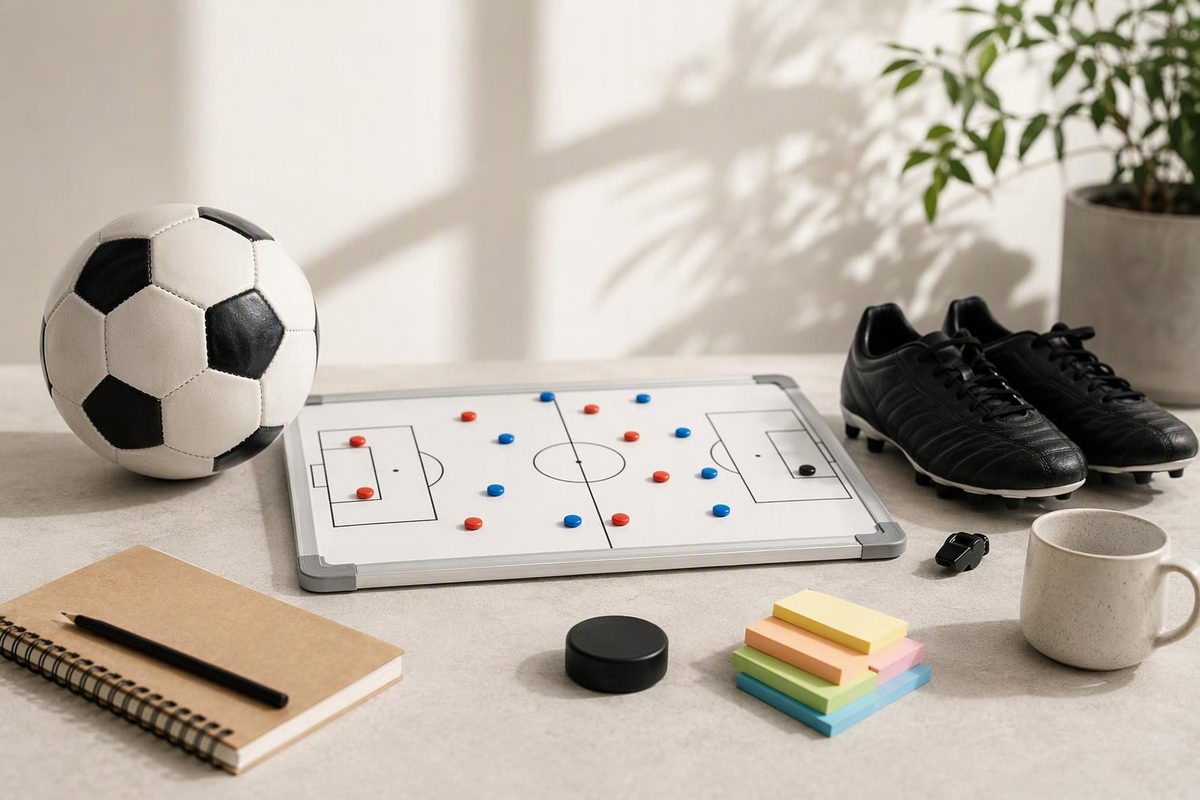
A build-out line is a field marking used in many U.S. small-sided youth competitions. When a goalkeeper controls the ball with the hands in the penalty area, or the defending team takes a goal kick, opponents must retreat behind the line. This gives the team in possession space to begin an attack from the back rather than immediately kicking long under pressure.
U.S. Soccer introduced build-out lines in its small-sided standards beginning at U9. Its guidance applied the line to 7v7 play and described the purpose as encouraging possession and playing out from the back in a less pressured setting (U.S. Soccer). Build-out lines are not part of the standard 11v11 Laws of the Game.
Where is the build-out line?
There is one in each half, running from touchline to touchline between the penalty area and halfway line. U.S. Soccer’s 7v7 framework places it equidistant between the top of the penalty area and the halfway line (US Youth Soccer’s Player Development Initiatives). Leagues may paint the line or mark its ends with cones.
It is better understood as a relative position than a fixed distance from goal. Youth fields and penalty areas vary in size, and competitions can modify the standard. Consult the field diagram or local rules rather than assuming every build-out line is the same number of yards from goal.
How it works during a match
Imagine the blue goalkeeper catches a shot:
- Red’s players retreat behind the build-out line in blue’s half.
- Blue’s defenders spread out to receive the ball.
- The goalkeeper distributes it using a method allowed by that competition.
- Red may cross the line and press when the competition’s release condition is met.
- Normal play continues; the build-out line does not remain a barrier.
The same retreat requirement ordinarily applies for a goal kick.
| Match situation | What opponents do | What happens next |
|---|---|---|
| Goalkeeper controls the ball with the hands | Retreat behind the build-out line | Press after the competition’s specified trigger |
| Defending team takes a goal kick | Begin behind the build-out line | Cross when permitted by the local rule |
| Throw-in, corner or free kick | Usually follow the normal restart distance | The build-out line normally has no special effect |
| Open play after release | Play normally | Players may move across the line in either direction |
One subtle point matters: “the ball is in play” and “opponents may cross the build-out line” do not always mean the same moment. Under the standard goal-kick law, the ball is in play once it is kicked and clearly moves (IFAB Law 16). A youth competition can still require opponents to remain behind its build-out line until a later event.
For example, PA West’s U10 policy, adopted in August 2026, keeps opponents back after a goal kick until a second player from the kicking team touches the ball, the ball exits the penalty area or it stops completely. Its goalkeeper-possession rule uses a similar set of triggers (PA West Soccer). Cal North District 2 uses different wording: for goalkeeper possession, the ball is in play upon release and need not leave the penalty area (Cal North District 2 rules).
The local rulebook—not a general explainer—therefore settles exactly when pressing may begin.
How the line changes offside
Under the common 7v7 modification, the build-out line nearest the opponents’ goal becomes the boundary beyond which an attacker can be in an offside position:
- A player cannot be penalized for offside while between halfway and that build-out line.
- A player can be in an offside position between the build-out line and the goal line.
- Crossing the line alone is not an offense. The usual tests involving the ball, the second-last opponent and involvement in active play still apply.
Suppose a winger is one yard beyond the opponents’ build-out line, toward goal, when a teammate passes. The winger is not automatically offside: the winger must also be nearer the goal line than both the ball and the second-last opponent, then become involved in active play. IFAB’s standard law likewise distinguishes being in an offside position from committing an offense (IFAB Law 11).
There is no offside offense when a player receives the ball directly from a goal kick. If a defender first receives the goal kick and then passes forward, however, offside is assessed when that second pass is played.
What the rule is designed to teach
The extra space creates a clearer learning problem for young players: Can the goalkeeper select a pass? Can defenders provide width and useful angles? Can the receiving player control the ball and find the next option?
It does not require a short pass, guarantee successful buildup or prove that one team is tactically superior. A team may still lose the ball as soon as pressure arrives. Likewise, completing several uncontested passes near goal can increase a team’s share of the ball without creating an attack—a useful limitation to remember when interpreting possession statistics.
Check these details before kickoff
Coaches, parents and referees should confirm four items in the competition rules:
- which age groups use the line;
- what goalkeeper distributions are legal, especially punts and drop kicks;
- the precise trigger that allows opponents to cross;
- the restart or sanction for early encroachment.
The basic principle is consistent: opponents give the goalkeeper’s team room to start playing. The exact mechanics can change by league.