
How Many People Are on a Soccer Field? The 22-Player Rule
A standard soccer match has 22 players on the field—11 per team. Learn how goalkeepers, red cards, substitutions and youth formats affect the count.
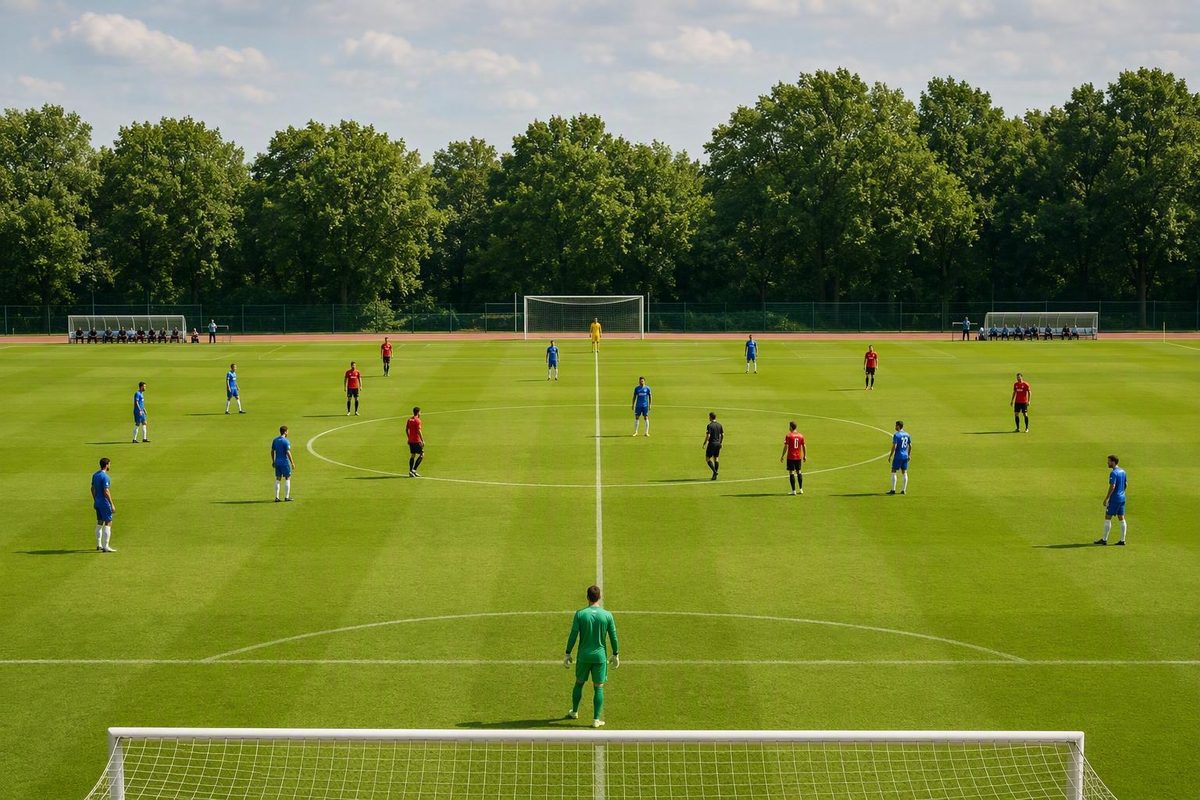
A standard soccer match has 22 players on the field at one time: 11 for each team. Each team has one goalkeeper and 10 outfield players. The official Laws set 11 as the maximum per team and require one of those players to be the goalkeeper (IFAB Law 3).
If you count the referee too, the usual headcount in the playing area is 23 people: 22 players plus the referee. Assistant referees, fourth officials and video officials are match officials but are not additional players; IFAB distinguishes these roles from the referee and lists which officials may be appointed (IFAB Law 6).
The player count at a glance
| Match situation | Team A | Team B | Total players |
|---|---|---|---|
| Both teams at full strength | 11 | 11 | 22 |
| One team has a player sent off | 10 | 11 | 21 |
| Each team has one player sent off | 10 | 10 | 20 |
| Both teams at the legal minimum | 7 | 7 | 14 |
The starting 11 is not 11 outfield players plus a goalkeeper. The goalkeeper is already included, so a common lineup can be counted as:
- 1 goalkeeper
- 4 defenders
- 3 midfielders
- 3 forwards
- 11 players total
The formation may change, but the number of playing slots does not.
Can a team play with fewer than 11?
Yes. Eleven is the maximum, not a number that must remain constant throughout the match. A team can temporarily have fewer players while someone is receiving treatment or waiting for permission to return. It also loses a playing slot after a red card: a player sent off after kickoff cannot be replaced (IFAB Law 3).
Under the 2026/27 Laws, a match generally may not start or continue if either team has fewer than seven players. IFAB identifies limited exceptions for temporary dismissals and specified off-field protocols (IFAB 2026/27 law changes). In the ordinary case, then, six players are too few for a team to continue.
Why substitutes do not raise the on-field count
Substitutes replace players; they do not add another playing slot. Under the substitution procedure, the replacement enters only after the departing player has left, and that entrance completes the substitution (IFAB Law 3).
This creates an important distinction in match statistics:
- Players on the field at once: no more than 11 per team.
- Players used during the match: potentially more than 11 because starters and substitutes can all record appearances.
For example, a team that starts 11 players and uses five substitutes has used 16 different players, but it has not fielded 16 simultaneously. A player-appearance total therefore measures participation, not team size at any one moment.
Why the count matters when reading match stats
A red card changes more than the lineup graphic. Ten players must cover the same field against 11, often prompting a team to defend deeper, concede possession or abandon an attacking role. That means a possession swing after a dismissal cannot be interpreted exactly like one produced with equal numbers.
When evaluating a match, record the score, minute and on-field player count alongside possession or shot figures. A team holding 65% possession against ten opponents has done something different from holding 65% in an 11-versus-11 phase. For the wider context, see what possession stats actually tell you.
Does every form of soccer use 11 players?
No. The 22-player answer applies to standard 11-a-side soccer. IFAB allows the number of players to be modified in youth, veterans, disability and grassroots soccer, so local formats may use smaller teams (IFAB general modifications). Futsal and informal five-a-side games also have their own formats rather than using the 11-a-side count.
For a regulation 11-a-side match, however, the simple answer is 11 players per team and 22 players in total.