
The Back-Pass Rule: What Goalkeepers Can and Cannot Handle
Passing to your goalkeeper is legal—but handling it may not be. Learn the back-pass rule, throw-in restriction, exceptions and indirect free-kick penalty.
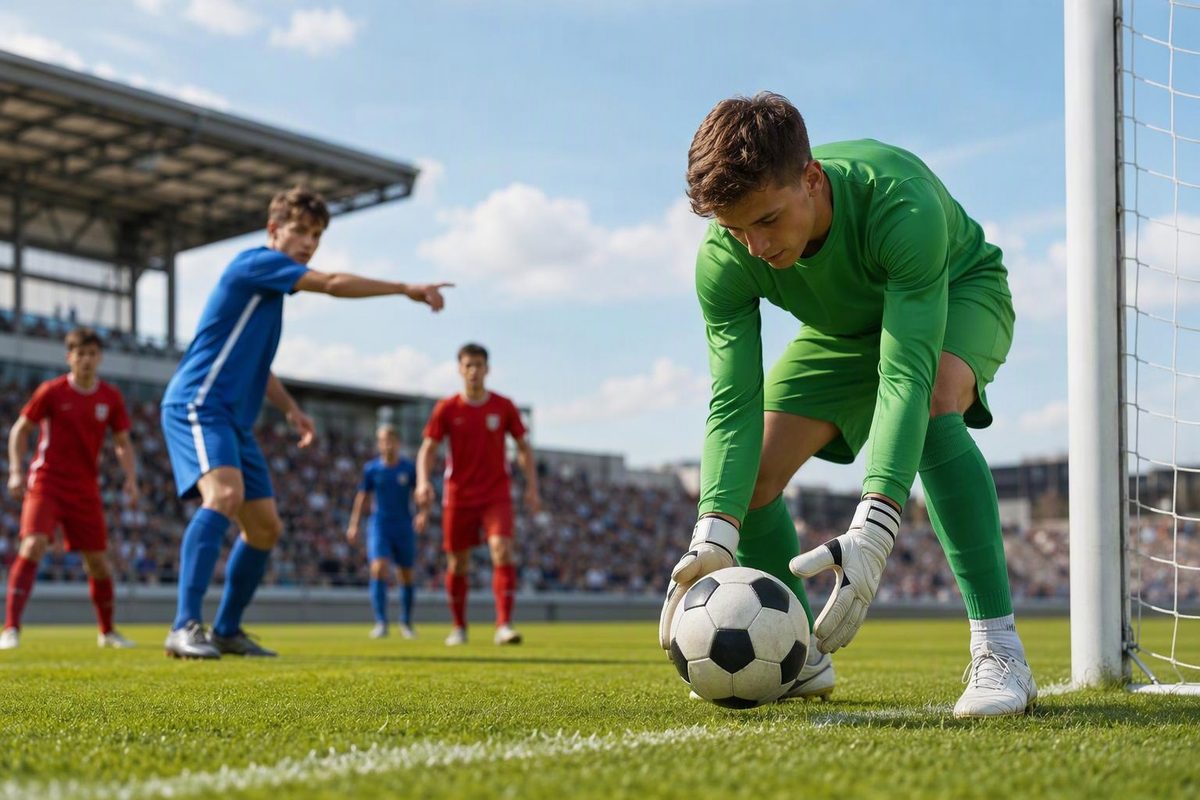
Passing to your goalkeeper is legal. The back-pass rule restricts when the goalkeeper can use their hands or arms. Inside their own penalty area, a keeper normally cannot handle a ball deliberately kicked to them by a teammate, or received directly from a teammate’s throw-in. The punishment is an indirect free kick, not a penalty kick. IFAB Law 12 sets out both restrictions and a failed-clearance exception.
Imagine a centre-back under pressure rolling the ball to the keeper. The keeper can control it with their feet and pass or clear it. Simply receiving that pass is not an offence. The handling restriction covers touching the ball with a hand or arm—not just picking it up.
What counts as a back-pass?
The key wording is “deliberately kicked to the goalkeeper.” Despite the name, the ball does not have to travel backwards: a sideways or forward kick to the keeper can trigger the same handling restriction. A genuine accidental rebound or a miskicked clearance not intended for the goalkeeper is different; the referee must judge whether the ball was deliberately kicked to them. Law 12 and its official examples
IFAB defines a kick as contact with the foot or ankle. That distinction explains why a normal header, chest pass or knee pass to the keeper does not carry the same restriction. IFAB glossary
| Match situation | Can the keeper handle it inside their own penalty area? |
|---|---|
| A teammate deliberately rolls a foot pass to the keeper | No, unless the failed-clearance exception applies |
| A teammate passes sideways to the keeper with their foot | No; direction does not change the rule |
| A teammate sends a normal header or chest pass to the keeper | Yes, provided it is not a deliberate trick to evade the rule |
| A ball accidentally rebounds off a teammate to the keeper | Yes; it was not deliberately kicked to the keeper |
| A teammate throws the ball directly to the keeper from a throw-in | No, unless the failed-clearance exception applies |
| The keeper controls a deliberate back-pass with their foot, then picks it up | No; a controlling touch alone does not remove the restriction |
These outcomes follow Law 12; the distinction is how the ball arrived, not simply which team last touched it. Outside their own penalty area, the goalkeeper is subject to the same handball rules as any other player.
A failed clearance is an exception; a trick is not
A genuine failed clearance can allow handling. If the goalkeeper has clearly kicked or attempted to kick the ball to release it into play, but the clearance is unsuccessful, they may then handle it. Merely stopping or dribbling the ball is not that exception. IFAB’s official explanation distinguishes an unsuccessful clearance from an intention to handle the pass. Law 12
A manufactured header is not a loophole. A defender cannot flick the ball up with their foot and then head it to the keeper as a deliberate trick to bypass the restriction. The player initiating the trick receives a yellow card, and the opponents receive an indirect free kick where the trick occurred, subject to the goal-area placement rule below—even if the keeper never uses their hands. If the goalkeeper initiated the trick, the goalkeeper is cautioned instead. IFAB Laws 12 and 13
Where is the free kick taken?
For an ordinary illegal back-pass handling offence, the indirect free kick is taken where the goalkeeper handled the ball. If that happens inside the goal area, the kick moves to the nearest point on the goal-area line parallel to the goal line.
The referee raises an arm to signal that the kick is indirect. Another player, from either team, must touch the ball before a goal can count. The ordinary handling offence carries no yellow or red card by itself. IFAB Law 13 and Law 12
What a back-pass tells you about passing statistics
A completed pass to the keeper can relieve pressure—or leave the keeper facing it. Completion alone does not tell you which.
In a hypothetical sequence, a defender completes nine of ten passes: 90% completion, calculated as completed passes divided by attempted passes, multiplied by 100. If several are short returns to the keeper, that percentage tells you the passes reached their target, not whether they advanced the attack or improved the next player’s options.
Watch what happens next: does the keeper find a free teammate, draw a presser out of position, or have to clear hurriedly? For a separate measure of forward movement, see how progressive passes are defined.