
Football Pitch Dimensions: Recommended Size and Legal Ranges
FIFA recommends a 105 × 68 m football pitch, but legal sizes vary. See the official ranges, goal dimensions and key pitch markings in metres.
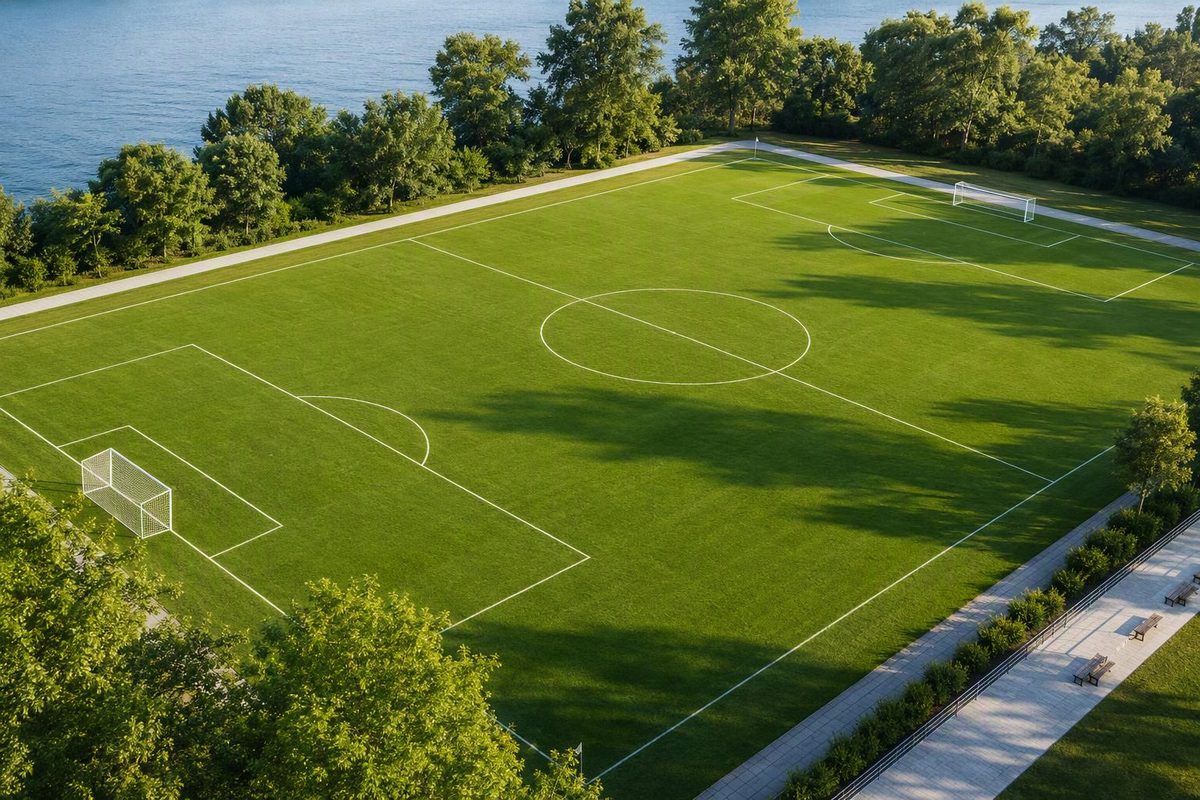
FIFA recommends a football pitch measuring 105 metres long by 68 metres wide. That is a playing area of 7,140 m². It is a recommended size, not the only size allowed under the Laws of the Game. FIFA’s stadium guidelines distinguish the field of play from the extra space around it.
For full-size, 11-a-side association football, the permitted dimensions are:
| Category | Length: along the touchline | Width: along the goal line |
|---|---|---|
| General Law 1 range | 90–120 m | 45–90 m |
| International matches | 100–110 m | 64–75 m |
| FIFA-recommended dimensions | 105 m | 68 m |
The legal ranges come from IFAB Law 1. The pitch must be rectangular, and the touchline must be longer than the goal line: the general limits do not permit a 90 × 90 m square.
Why football pitches are not all the same size
The Laws allow a range, while individual competitions can specify dimensions within that range. So “regulation size” does not necessarily mean exactly 105 × 68 m, and the international range does not mean every international competition accepts every size within it. Check the competition rules when an exact requirement matters. IFAB explicitly allows competitions to determine pitch dimensions.
Length runs from one goal line to the other; width runs from one touchline to the other. Measurements are taken from the outside edges of the boundary lines, because the lines belong to the areas they enclose.
The surrounding grass, run-off space, warm-up areas and space for advertising boards are additional to the field of play. A 105 × 68 m pitch therefore needs a larger overall site; those figures are not a stadium-footprint specification. FIFA’s guidelines explain the distinction.
Goal and pitch-marking dimensions
Although the overall pitch size can vary, the following dimensions are fixed under IFAB Law 1:
- Goal opening: 7.32 m wide between the inside edges of the posts, and 2.44 m high from the ground to the underside of the crossbar.
- Penalty area: 16.5 m deep. Each side extends 16.5 m outward from the inside of its corresponding goalpost, giving a calculated total width of 40.32 m.
- Goal area: 5.5 m deep, with each side 5.5 m outward from the inside of its corresponding post: 18.32 m wide in total.
- Penalty mark: 11 m from the midpoint between the posts, measured from the centre of the mark to the back edge of the goal line.
- Centre circle and penalty arc: each has a radius of 9.15 m.
- Corner arc: a quarter-circle with a radius of 1 m.
The “18-yard box” is therefore 16.5 m deep, not 18 m. Likewise, the “six-yard box” is 5.5 m deep.
Why pitch size matters when reading match data
A percentage-based location measures a share of the pitch, not a fixed distance. Suppose a graphic places an action 80% of the way along the pitch, measured from a team’s own goal line. The denominator is the pitch’s full length:
- On a 105 m pitch, that position is 84 m along, leaving 21 m to the opposite goal line.
- On a 100 m pitch, it is 80 m along, leaving 20 m.
Those are illustrative calculations, not match observations. The same relative position can represent different distances in metres—and distance to the goal line is not necessarily distance to the centre of the goal, because the player’s sideways position also matters. When interpreting location-based statistics, check whether the coordinates represent metres or a normalised pitch scale.