
Why Premier League Added Time Looks Shorter in 2026/27
Premier League added time looks shorter as new rules deter delays before they happen. Fewer extra minutes can still mean more football.
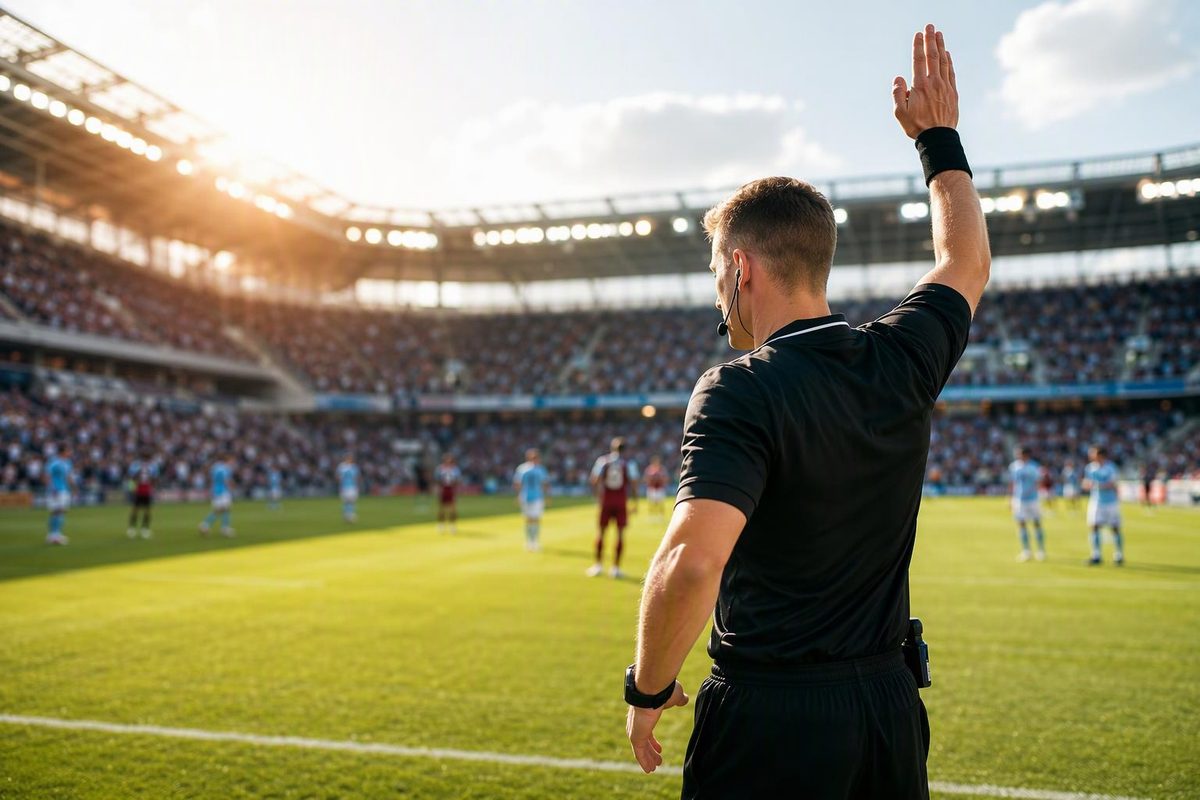
Premier League added time looks shorter in 2026/27. The most likely explanation is that referees now have stronger tools to prevent delays, rather than merely compensate for them at the end of each half. Early-season figures are consistent with that explanation, but it is too soon to establish how much of the change the new rules caused.
The important distinction is between added time and ball-in-play time. Added time is the minimum period the referee adds for time lost during a half. Ball-in-play time counts only the seconds when the ball is live. A match can therefore have a smaller number on the fourth official’s board while delivering more actual football.
What added time measures
Under Law 7, the referee allows for time lost to substitutions, injuries, time-wasting, disciplinary sanctions, medical breaks, VAR delays, goal celebrations and other significant interruptions. The board displays a minimum, which the referee may increase but not reduce (IFAB Law 7).
It is not a promise to make the ball live for 60, 65 or 70 minutes. Ordinary out-of-play periods—including routine throw-ins and goal kicks—do not all generate second-for-second compensation.
That denominator matters. “Five minutes added” means at least five minutes will be played beyond the regulation 45-minute half; it does not mean only five minutes were spent with the ball out of play.
The 2026/27 rules make wasting time costlier
The main change is an immediate sporting penalty for certain delays.
| Source of delay | 2026/27 response | Why it can reduce added time |
|---|---|---|
| Delayed throw-in | Visible five-second countdown; possession reverses if it expires | Players have a reason to restart sooner |
| Delayed goal kick | Five-second countdown; opponents receive a corner if it expires | Delay can surrender an attacking set piece |
| Slow substitution | Departing player has 10 seconds; the replacement can be held out if the limit is exceeded | A team risks playing temporarily with 10 |
| Injury stoppage | The treated outfield player generally stays off for one minute after play restarts | Using treatment to break momentum carries a cost |
| Goalkeeper injury stoppage | In the Premier League trial, an outfield teammate must leave for at least one minute | The stoppage can create a temporary numerical disadvantage |
These measures are not universal countdowns on every restart. The throw-in and goal-kick countdown begins when the referee judges that the restart is taking too long or is being deliberately delayed. IFAB introduced the measures to improve match flow, and the Premier League adopted them alongside its goalkeeper-injury trial (IFAB; Premier League).
The Premier League is also emphasizing more efficient VAR use. Shorter checks mean fewer lost seconds to recover later, although a difficult review can still produce a large block of added time.
Fewer extra minutes can mean more football
Consider two simplified second halves:
- Match A: repeated slow restarts create eight minutes of recoverable delay, so eight minutes are displayed.
- Match B: countdowns and sanctions encourage quick restarts, leaving four minutes to recover, so four are displayed.
Match B finishes earlier but may contain more live action. The smaller added-time number is then a sign that less compensatory time was needed—not that the referee ignored interruptions.
Early 2026/27 data fits that explanation without proving it. According to 365Scores, average ball-in-play time rose from 55:23 across the full 2025/26 season to 57:28 through the first three matchweeks of 2026/27, an increase of 2:05 (365Scores). Three rounds are a small sample, and their mix of goals, injuries, VAR reviews and match states may differ from a full season.
Why the change feels so noticeable
The contrast is sharp because the previous reform worked differently. From 2023/24, officials made a more detailed allowance for time lost. In the first 203 matches of that season, average match duration increased from 98:27 in 2022/23 to 101:42, while ball-in-play time increased from 54:52 to 58:37. Goals after 90 minutes also rose from 0.22 to 0.39 per match (Premier League).
That policy recovered more lost time but also produced conspicuously large boards. The 2026/27 approach is intended to preserve live action without allowing avoidable delays to accumulate in the first place.
So the short answer is: Premier League added time appears shorter because restarts, substitutions and injury interruptions are being managed more proactively. It does not automatically mean less football. To judge whether the policy is working over the season, compare added time with ball-in-play time and total match duration—not the board alone.