
Top Scorers in Soccer History: Why the Totals Differ
Ronaldo leads RSSSF’s men’s top-level ranking. Compare the top 10, dated totals, and why Pelé and Bican have different career goal counts.
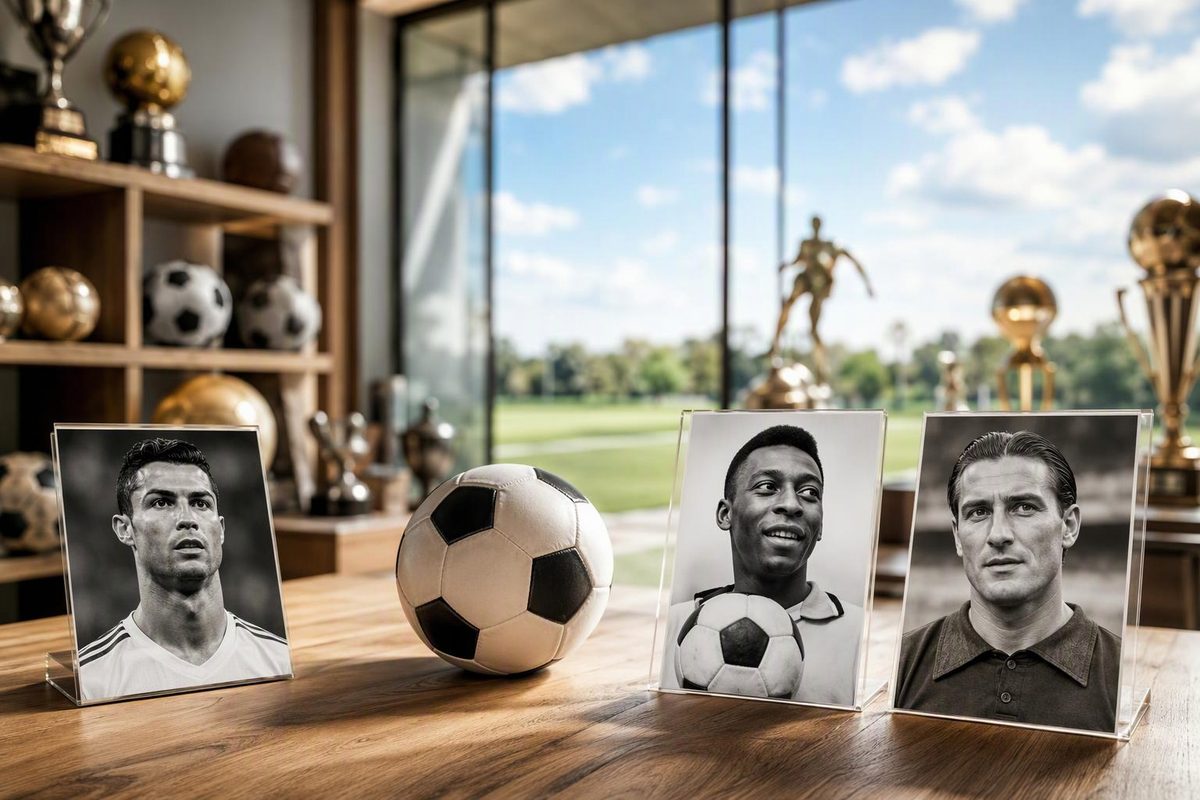
Cristiano Ronaldo leads RSSSF’s all-time men’s ranking for official goals at top level, ahead of Lionel Messi. Pelé, Romário, Ferenc Puskás and Josef Bican follow in its July 2026 snapshot—but totals depend on which matches the compiler includes. RSSSF’s Prolific Scorers Data.
A career goal total counts goals credited to a player across a defined set of matches. It is a cumulative number, not a scoring rate: there is no appearances or minutes denominator. Before comparing the top scorers in soccer history, the key question is therefore which games count?
The top 10 in RSSSF’s top-level category
The table below reproduces the Rec.Sport.Soccer Statistics Foundation’s “Official Matches – Top level” category. RSSSF labels this a preliminary list, not a definitive governing-body record. Its page was updated on 3 August 2026, with a stated match cutoff of 19 July 2026. These are that dated snapshot’s totals, not live October figures. RSSSF’s ranking and update dates.
| Rank | Player | Official top-level goals |
|---|---|---|
| 1 | Cristiano Ronaldo | 978 |
| 2 | Lionel Messi | 921 |
| 3 | Pelé | 770 |
| 4 | Romário | 761 |
| 5 | Ferenc Puskás | 760 |
| 6 | Josef Bican | 743 |
| 7 | Robert Lewandowski | 697 |
| 8 | Jimmy Jones | 659 |
| 9 | Abe Lenstra | 645 |
| 10 | Gerd Müller | 640 |
Ronaldo, Messi and Lewandowski were marked active at the source’s cutoff. “Top level” is the compiler’s category; it does not mean every goal came against opposition of equal strength.
Keeping one source and one category avoids mixing counting systems. Taking Ronaldo’s total from a senior-career tracker, Bican’s from a broader historical archive and Pelé’s from an all-matches record would not produce a like-for-like comparison.
Why Pelé and Bican have several totals
Official does not always mean senior first-team only
RSSSF also maintains a broader official-matches list. Its inclusion rules cover regional, reserve and amateur leagues, several types of representative teams, certain traditional tournaments and cancelled games. That list puts Bican at 950-plus goals, compared with 743 in its top-level category. The plus sign means a documented lower bound, not an exact final total. RSSSF’s categories and inclusion rules.
Bican’s detailed record shows why the distinction matters: it includes 99-plus goals in second- and third-level leagues, 33-plus in reserve leagues, and goals in winter tournaments and regional or city selections. These are identifiable match categories, not simply a larger estimate of the same senior top-level record. RSSSF’s Bican breakdown.
There are also competing historical reconstructions. In January 2021, the Czech FA reported 821 official goals for Bican, counting first- and second-league matches, cups and national selections, while excluding club friendlies. Sky Sports reproduced the federation’s statement and its counting rules; Czech Television also reported the archive work behind the figure. That total should be attributed to the Czech FA’s 2021 reconstruction, rather than presented as interchangeable with RSSSF’s total. Sky Sports report; Czech Television report.
All-matches records answer a different question
Pelé’s famous four-figure total belongs to a broader record. Guinness’s career-goals record page lists 1,279 goals in 1,363 games between September 1956 and October 1977, plus two goals in later special appearances. Guinness career-goals record.
RSSSF’s detailed Pelé archive separates official matches from friendlies and other appearances. Its broader official tally is 778, with another 546 goals in its friendly column. Neither that tally nor Guinness’s record uses the same match set as the table above. RSSSF’s Pelé breakdown.
The fair comparison is not “which published number is largest?” It is “which numbers were produced using the same rules?”
Do penalties and international friendlies count?
A penalty scored during a counted match contributes one goal, just like an open-play finish. A shootout conversion does not add to the player’s match-goal total: IFAB specifies that shootouts take place after the match has ended. IFAB Law 10.
“Friendly” also needs qualification. Recognised senior national-team friendlies can count toward international records even when club exhibition games are excluded—as the Czech FA’s Bican statement illustrates. Excluding every match labelled a friendly would therefore create another, different ranking.
Most goals is not the same as the best scoring rate
Gerd Müller scored 365 goals in 427 Bundesliga appearances, according to the league: approximately 0.85 goals per appearance. The denominator is matches played, including substitute appearances—not full 90-minute matches. Bundesliga’s Müller record.
A substitute who scores once in ten minutes has one goal per appearance, just as a starter who scores once in 90 minutes does. Goals per 90 accounts for that playing-time difference, but still does not adjust for chance quality, penalties, role or opposition.
Career totals reward both scoring output and longevity. For a narrower comparison, use a common competition and its eligibility rules, such as the Champions League all-time scoring list, rather than treating every career goal as an equally difficult achievement.
The international record is a separate category
The table above concerns men’s club-and-country totals. For senior international goals across women’s and men’s soccer, FIFA identifies Christine Sinclair as the leader, with 190 goals in 331 appearances for Canada. That is a national-team record, not a combined club-and-country total. FIFA’s Sinclair profile and interview.