
Who Leads Soccer’s Single-Match Tackle Rankings And What Counts
Compare Sørensen and Obbadi’s 16-tackle matches with the Premier League’s 14-tackle leaders, including coverage limits and why tackles differ from possession wins.
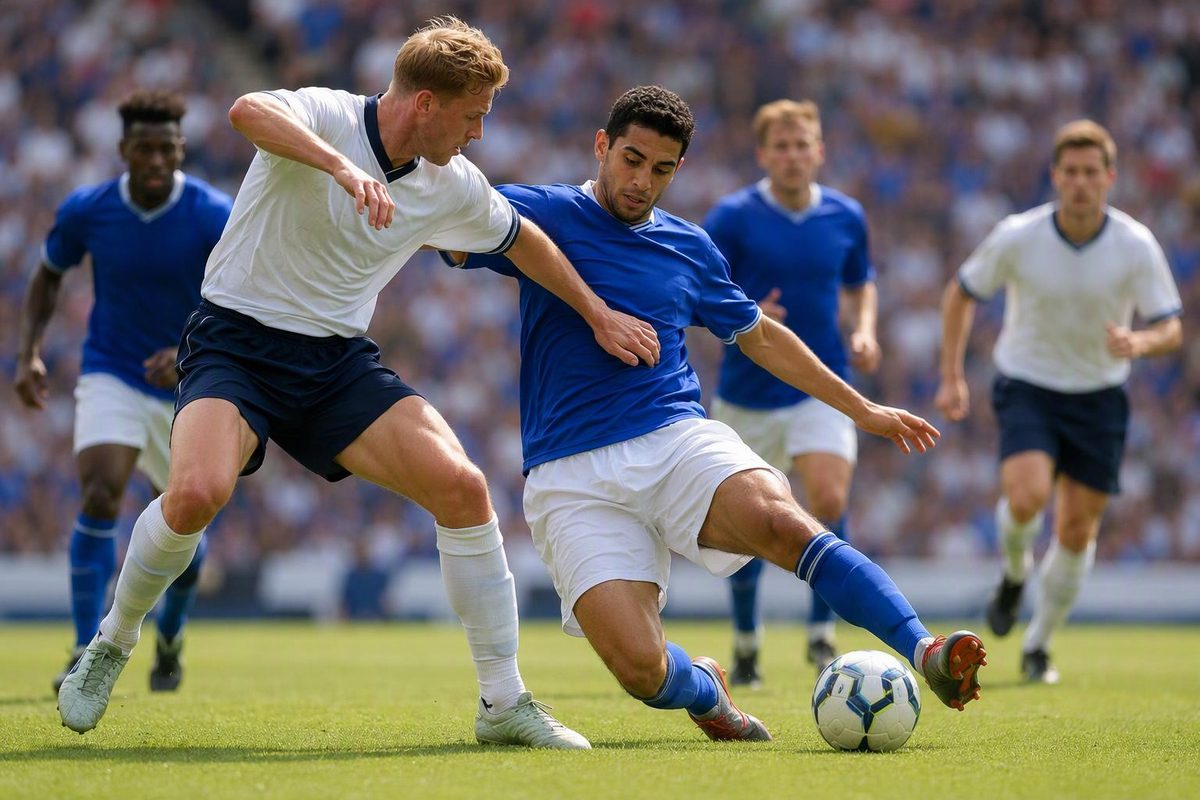
Frederik Sørensen and Mounir Obbadi share the highest individual single-match tackle total in StatMuse’s available data for Europe’s top five leagues: 16 each. In its Premier League dataset, N’Golo Kanté and Harrison Reed share the lead with 14. These are leaders within the provider’s coverage, not established worldwide, all-time soccer records.
The distinction matters twice: the rankings cover particular competitions and periods, and a recorded tackle is not necessarily a possession win. The most defensible answer to “most tackles in a game” therefore names the player, total and dataset together.
Choose a ranking scope to compare the leaders, then expand a match for its date and coverage caveat.
Single-Match Tackle Leaders
16: Five-league leaders
14: Premier League leaders. Both are joint leads within available coverage.
| Player | Match / Details | Tackles |
|---|---|---|
| Frederik Sørensen | Köln vs Bayern MunichDate and scope19 March 2016. Joint leader in StatMuse’s available five-league data. Bundesliga tackle coverage starts in 2014/15. | 16 |
| Mounir Obbadi | Verona vs EmpoliDate and scope17 May 2015. Joint leader in StatMuse’s available five-league data. Coverage varies by competition before 2015/16. | 16 |
| N’Golo Kanté | Chelsea away at LiverpoolDate and scope31 January 2017. Joint Premier League leader within coverage starting in 2014/15. The Premier League reports nine tackles won from his 14 tackles. | 14 |
| Harrison Reed | Southampton vs EvertonDate and scope20 December 2014. Joint Premier League leader within coverage starting in 2014/15. | 14 |
Sources: StatMuse’s five-league, Premier League and Bundesliga rankings cited in the article; Kanté’s outcome split from Premier League analysis. These are individual totals, not worldwide all-time records.
The Highest Recorded Totals Are 16 And 14
The four leading performances belong to two different ranking scopes. Sørensen and Obbadi lead the selected five-league dataset; Kanté and Reed lead the Premier League dataset. A Premier League leader does not need to equal the highest total across all five leagues.
| Player | Match | Date | Tackles |
|---|---|---|---|
| Frederik Sørensen | Köln vs Bayern Munich | 19 March 2016 | 16 |
| Mounir Obbadi | Verona vs Empoli | 17 May 2015 | 16 |
| N’Golo Kanté | Chelsea away at Liverpool | 31 January 2017 | 14 |
| Harrison Reed | Southampton vs Everton | 20 December 2014 | 14 |
Sørensen’s total and opponent appear in StatMuse’s Bundesliga ranking. Obbadi’s 16 tackles in Verona’s 2–1 victory are corroborated by a contemporary WhoScored analysis published by Bleacher Report. Reed’s 14 in Southampton’s 3–0 win are also reported in TEAMtalk’s matchweek review.
Those contemporary reports help corroborate particular performances. They do not establish that every earlier match, every competition or every data provider has been searched. Confirming a player’s total and proving an unrestricted historical record are different tasks.
The table also concerns individual players, not combined team totals. A team’s tackles are distributed across its players, so a club’s match total cannot be substituted into this ranking. Likewise, a season total or a tackles-per-match average answers a different question from the largest count in one fixture.
The Coverage Starts Too Late For An All-Time Claim
StatMuse says its Premier League and Bundesliga tackle data go back to 2014/15. Its five-league ranking says coverage varies by competition before 2015/16. These boundaries are part of the answer, not a minor qualification to remove from a record headline.
Reed’s match falls in the Premier League’s stated starting season. Obbadi’s match also comes before 2015/16, the point before which the five-league ranking flags variation in coverage. His appearance in the results shows that the dataset includes that performance; it does not show that all earlier matches across the selected leagues are covered equally.
A ranking can establish the largest value among the records it contains. It cannot rule out a larger value in a match it does not contain. Older fixtures and competitions outside the selected leagues therefore remain outside what these results can settle.
The safe wording is “joint highest in StatMuse’s available five-league data” for Sørensen and Obbadi, and “joint highest in StatMuse’s available Premier League data” for Kanté and Reed. Calling either pair the unrestricted soccer record-holders would go beyond the evidence. The supplied sources do not establish a worldwide maximum.
A Tackle Removes The Ball, But May Not Secure Possession
Under Opta’s event definitions, a tackle is a legal, ground-level challenge in which a player connects with the ball and takes it away from an opponent who had controlled possession. The opponent’s prior control and the defender’s contact with the ball distinguish this event from several other defensive actions.
Opta then separates the outcome. A tackle won means the tackler or a teammate gains possession, or the ball goes safely out of play. A tackle lost means the challenge takes the ball away from the carrier, but the ball goes to an opposition player. Both outcomes count towards total tackles.
That makes “tackle lost” easy to misread. It does not mean the defender failed to touch or remove the ball. The tackle event has occurred, but the subsequent outcome favours the opposition. A player can therefore raise their tackle total without ending the opponent’s possession.
| Event | What It Means Under Opta |
|---|---|
| Tackle won | Ball removed; teammate gains possession or ball goes safely out |
| Tackle lost | Ball removed; an opposition player receives it |
| Challenge lost | Defender is beaten by a dribbler without winning the ball |
A defender beaten by a dribbler receives a separate challenge lost, rather than a tackle lost. Interceptions, clearances and shot blocks are also separate events. They can contribute to a strong defensive performance without adding to the tackle count.
These are Opta’s definitions, not a universal terminology rule for every statistics site. A column called “tackle attempts” may not describe the same population of actions as one called “tackles.” Before comparing totals from different providers, check what each includes rather than relying on similar-looking labels.
Total Tackles Are Not A Complete Success Rate
A high tackle count establishes a high volume of the specified event. It does not tell you how many times a defender was beaten, how often the ball stayed with the opposition after a challenge, or how much defensive work happened without a tackle.
Even “tackles won” needs its definition attached. Under Opta’s rule, a safe outcome with the ball going out of play can qualify. That is not the same as the defender’s team retaining controlled possession on the pitch.
The distinction also affects denominators. Dividing tackles won by total tackles gives the share of recorded tackles classified as won. It does not automatically give the success rate across every defensive challenge the player attempted, because challenges lost are a separate category. Changing the denominator changes the question being answered.
For the record comparison here, the relevant number is total recorded tackles. That is why a ranking of tackles won, interceptions or combined defensive actions cannot replace it without changing the claim.
Kanté’s 14 Tackles Included Nine Tackles Won
Chelsea’s 1–1 draw at Liverpool provides a concrete example of the difference. Kanté made 14 tackles, but the Premier League’s tactical analysis records nine tackles won from those 14.
His tackles-won share was 9 ÷ 14 × 100 = 64.3%, rounded to one decimal place.
The calculation uses 14 recorded tackles as its denominator. It should be described as a tackles-won share, not as proof that Kanté succeeded in 64.3% of all attempted defensive challenges. The cited figures do not supply the complete attempted-challenge denominator needed for that broader claim.
Nor should the nine tackles won become “nine times Chelsea kept the ball.” Opta’s definition includes safe outcomes when the ball goes out of play. The summary figure does not split those outcomes from occasions when Kanté or a teammate gained possession.
This is why changing the label from “14 tackles” to “14 possession wins” is not harmless shorthand. It changes what happened in the match. The original total measures qualifying challenges that removed the ball from a controlled opponent; the possession claim would require a different outcome count.
His Defensive Assignment Explains The Volume
The league’s analysis describes Kanté moving towards the touchlines to cover behind Chelsea’s attacking wing-backs. That coverage allowed the back three to stay compact. His tackles were part of a specific defensive assignment, not simply a measure of how active he was in central midfield.
The location of a tackle matters because the same event count can arise from different jobs. Covering space behind an advanced teammate creates a different set of interventions from defending a compact central position. A raw match total does not show those locations or responsibilities by itself.
Kanté’s performance therefore supports two separate statements: he reached the Premier League dataset’s joint-leading tackle total, and the tactical account explains how his movement supported Chelsea’s structure. The total alone cannot supply the second statement; that requires the match analysis.
For the other leaders, the figures and corroborating reports establish the listed counts and match details. They do not provide the same tackles-won breakdown used here for Kanté. Those missing outcome figures should remain unknown rather than being inferred from the final score or from the size of the tackle total.
A Higher Tackle Count Does Not Automatically Mean Better Defending
A player can make many tackles because they repeatedly solve difficult defensive situations. They can also have many opportunities because opponents keep attacking their area. The count records the interventions, not the reason so many became necessary.
Good positioning may prevent an opponent from attempting a pass or dribble in the first place. No tackle is recorded when a defender closes an option without needing to challenge for the ball. A lower total can therefore coexist with effective defending; the number is not a complete inventory of defensive value.
Minutes And Opportunities Change The Comparison
A single-game tackle total is a raw count. It is not divided by minutes played, opposition possession or opportunities to challenge. A substitute has less time to accumulate events, while a player facing repeated ball-carrying attacks may have more chances to tackle than someone whose opponent rarely reaches their zone.
The record table does not supply minutes played, opposition-possession figures or an opportunity-adjusted measure for these performances. It would therefore be unsupported to turn the four totals into a ranking of tackling efficiency. The available comparison is volume in one match.
Possession can help explain exposure, but it still does not identify where that exposure occurred. An opponent may have the ball without repeatedly confronting a particular defender. As with possession percentage, a match statistic describes one part of the game rather than resolving the whole performance.
Outcomes And Chances Conceded Add The Missing Context
Tackles won and challenges lost help distinguish removing the ball, securing a favourable outcome and being beaten. Reading them alongside total tackles gives a more useful account than treating every recorded tackle as an identical success.
Role and location explain the assignment; chances conceded help assess whether the defensive work limited danger. None of those comparisons should be manufactured from the record count. A large total cannot, on its own, show whether a player protected the most dangerous space or whether the team’s overall defensive plan worked.
The supplied record evidence answers the narrow question well: 16 is the highest individual match total in the cited five-league dataset, and 14 is the highest in the cited Premier League dataset. It does not establish the greatest defensive performance, the most possession wins, or a worldwide all-time maximum. Keeping those claims separate is what makes the ranking usable.