
N’Golo Kanté Made 156 Interceptions in 2015/16—but Is It the All-Time Record?
Kanté made 156 Premier League interceptions in 2015/16. See what the stat counts, his per-90 rate and why the record needs a data-coverage caveat.
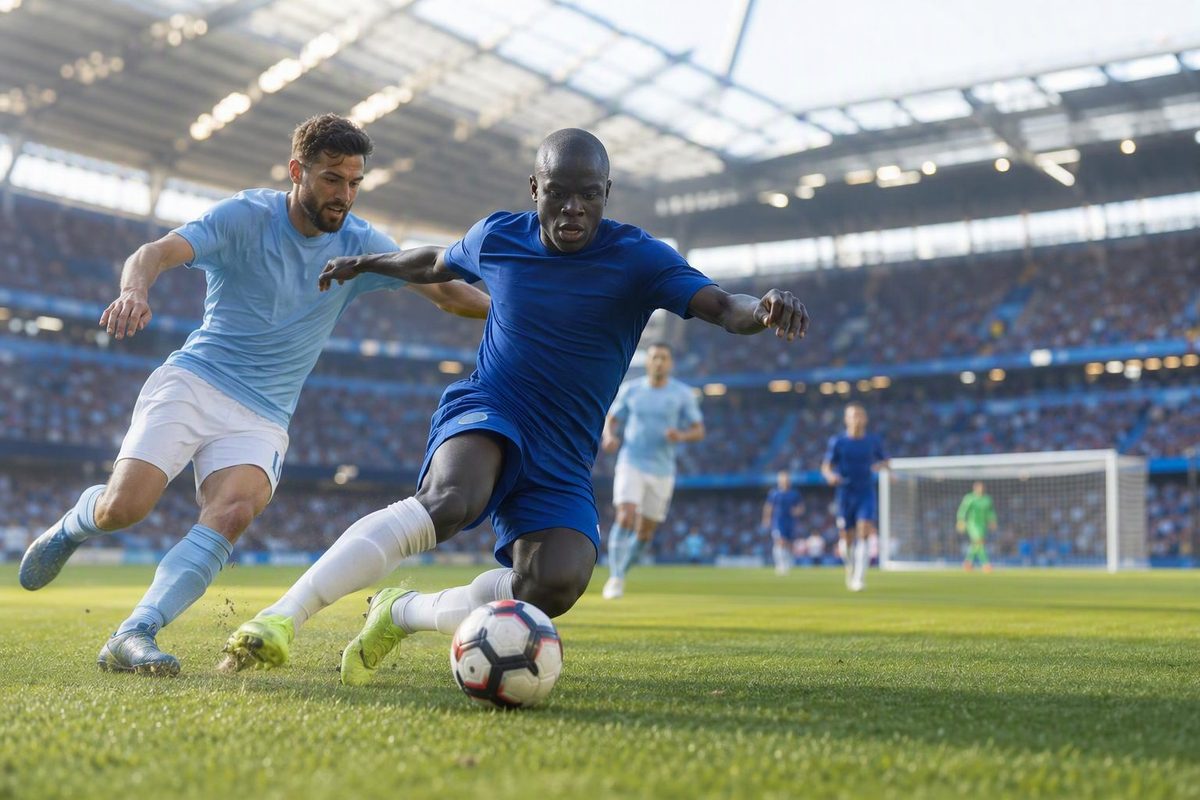
N’Golo Kanté made 156 interceptions for Leicester City in the 2015/16 Premier League season. The Premier League’s review of Leicester’s title win confirms that his 156 interceptions were the most in the division that season.
That is the best-supported answer to “most interceptions in a season” when the intended competition is the Premier League. It should not, however, be presented as an unqualified record covering every season since the league began in 1992.
The leading totals in the available dataset
StatMuse ranks Kanté first in its Premier League season table, ahead of Idrissa Gana Guèye’s 141 for Aston Villa in the same campaign. But the StatMuse interception dataset starts with 2014/15, so this table establishes the highest total within that tracked period, not necessarily across the Premier League’s entire history.
| Rank in dataset | Player | Season | Interceptions | Matches | Minutes |
|---|---|---|---|---|---|
| 1 | N’Golo Kanté | 2015/16 | 156 | 37 | 3,020 |
| 2 | Idrissa Gana Guèye | 2015/16 | 141 | 35 | 3,075 |
| 3 | Laurent Koscielny | 2015/16 | 126 | 33 | 2,846 |
| 4 | Yohan Cabaye | 2015/16 | 120 | 33 | 2,704 |
| 5 | José Fonte | 2014/15 | 118 | 37 | 3,330 |
The precise wording is: Kanté’s 156 is the highest Premier League season total in StatMuse’s data from 2014/15 onward, and the Premier League confirms that he led the competition in 2015/16.
What counts as an interception?
An interception is not every occasion on which a defender gets a foot to a pass. Under Opta’s event definition, it occurs when a player reads an opponent’s pass and moves into its intended line to intercept the ball.
Opta separates it from three nearby events:
- Tackle: taking the ball from an opponent who has controlled possession in a legal, ground-level challenge.
- Blocked pass: cutting out a pass with less evidence of reading and moving into its line.
- Ball recovery: establishing control after possession changes in open play.
That distinction matters when comparing leaderboards. A record should be tied to the provider or competition database that produced it rather than assembled from sites using unknown or incompatible definitions.
Kanté’s interceptions per 90 minutes
The 156 figure is a season total. The denominator for a playing-time-adjusted comparison is Kanté’s 3,020 league minutes:
156 ÷ 3,020 × 90 = 4.65 interceptions per 90 minutes
The Premier League expressed the same output as one interception every 19.3 minutes. Guèye’s 141 in 3,075 minutes equals about 4.13 per 90, so Kanté led him in both total volume and playing-time-adjusted rate.
Per-90 figures correct for different workloads, but not for different opportunities. A midfielder whose team spends longer without the ball may have more opposing passes available to intercept than one playing for a possession-heavy side. Opponent passes or defensive possessions while the player is on the pitch would provide better opportunity-based denominators, but they are not included in this season leaderboard.
Why Leicester’s system matters
Kanté’s total came in a particular match environment. Leicester generally used a 4-4-2 that became a 4-4-1-1 without the ball, according to the Premier League’s tactical review. The champions averaged 42.43% possession, the lowest recorded for a Premier League champion since that data began in 2003/04.
That did not make Leicester inferior; it described how they played. They were comfortable defending in two compact banks, regaining the ball and attacking quickly. Kanté’s anticipation and range suited that plan, while Leicester’s time without the ball also affected how many interception opportunities arose. For more on why time with the ball is not the same as control, see what possession statistics actually tell you.
How to read the 156
Kanté’s total is strong evidence of frequent pass-reading and defensive activity across a heavy workload. It is not, by itself, proof of the best defensive season ever.
Interception totals are shaped by anticipation, team structure, minutes played, opposition passing volume and the provider’s event definitions. To assess performance rather than simply count events, pair interceptions with playing time, opportunity, location and what happened after the ball was cut out.
The short answer is therefore N’Golo Kanté, with 156 Premier League interceptions in 2015/16—with the caveat that the cross-season leaderboard cited here begins in 2014/15.